
At Preston Rowe Paterson we pride ourselves on delivering insurance valuations that combine rigour, depth and a genuine understanding of our clients’ needs, an approach that’s been forged through decades of industry experience
Our firm is adept at navigating all asset classes, from the straightforward to the highly specialised, aiming to ensure that our clients are not left exposed to the circumstances of underinsurance or the complications of co-insurance
We don’t believe in a one-size-fits-all approach. Working hand in hand with insurance brokers, our team takes the time to understand the unique priorities of every client, whether you’re an investor, a developer, or an owner-occupier.
This commitment to tailored solutions means each valuation is meticulously suited to the specific property, plant, or machinery in question, no matter how complex or mainstream.
Our service extends beyond the initial valuation. We’re dedicated to staying by your side with regular reviews and agile desktop updates, helping you fine-tune insured sums as your portfolio evolves. With Preston Rowe Paterson, you can be confident that your assets are protected by valuations rooted in precision, integrity and a genuine desire to safeguard your interests.
Our insurance valuation real property types include:-
- Affordable & Social Housing
- Aged Care Facilities
- Automotive Related Property
- Boarding Houses
- Build To Rent Residential
- Business Parks
- Car Dealerships
- Childcare Centres
- Data Centres
- Entertainment Venues – Cinemas, Theatres & Auditorium
- Extractive Industries & Resource – Based Enterprises
- Golf Courses
- Green Energy – Wind Farms, Solar Farms & Pumped Hydro
- Heritage
- Heritage Hotel
- Heritage Office
- Heritage Retail
- Heritage Residential
- Hospitals & Health
- Hotels (Accommodation) & Resorts
- Hotels (Pubs), Motels & Caravan Parks
- Industrial Manufacturing
- Infrastructure Including Toll Roads, Airports & Shipping Port Facilities
- Land Lease Residential Development
- Large Format Bulky Goods Retail
- Logistics & Industrial, Office/Warehouses & Factories
- Marinas
- Medical Centres
- Metropolitan & CBD Commercial Office Buildings
- Other Specialised & Alternative Asset Classes
- Residential Communities
- Residential Development Project
- Residential Dwellings (Houses/Apartments/Units)
- Retail Shopping Centres
- Retail Shops
- Retirement Living
- Rural & Agribusiness Properties
- Self‑Storage Facilities
- Service Stations
- Strata Commercial, Retail, & Industrial
- Student Accommodation
- Student Housing
- Vehicle Storage Facilities
Our insurance valuation plant, machinery and equipment types include property types include:-
- Airport & Shipping Port Plant & Equipment
- Farming Equipment
- Fittings & Equipment
- Industrial/Factory Equipment
- Licensed Club Furniture, Fittings & Equipment
- Hotel Furniture, Fittings & Equipment
- Mining & Earth Moving Equipment/Road Plant
- Office Fit Outs & Equipment
- Resort, Accommodation & Hotel Furniture
- Transport Equipment
- Other General Plant & Equipment
Clarifying the Differences for Precise Insurance Coverage
Accurate estimation of the sum insured is essential when insuring real property, plant, or machinery, as it helps prevent underinsurance and ensures adequate protection.
Two commonly referenced terms in insurance valuation are replacement cost and reinstatement cost. Although these terms appear similar, they represent distinct concepts, each with specific implications for insurance arrangements.

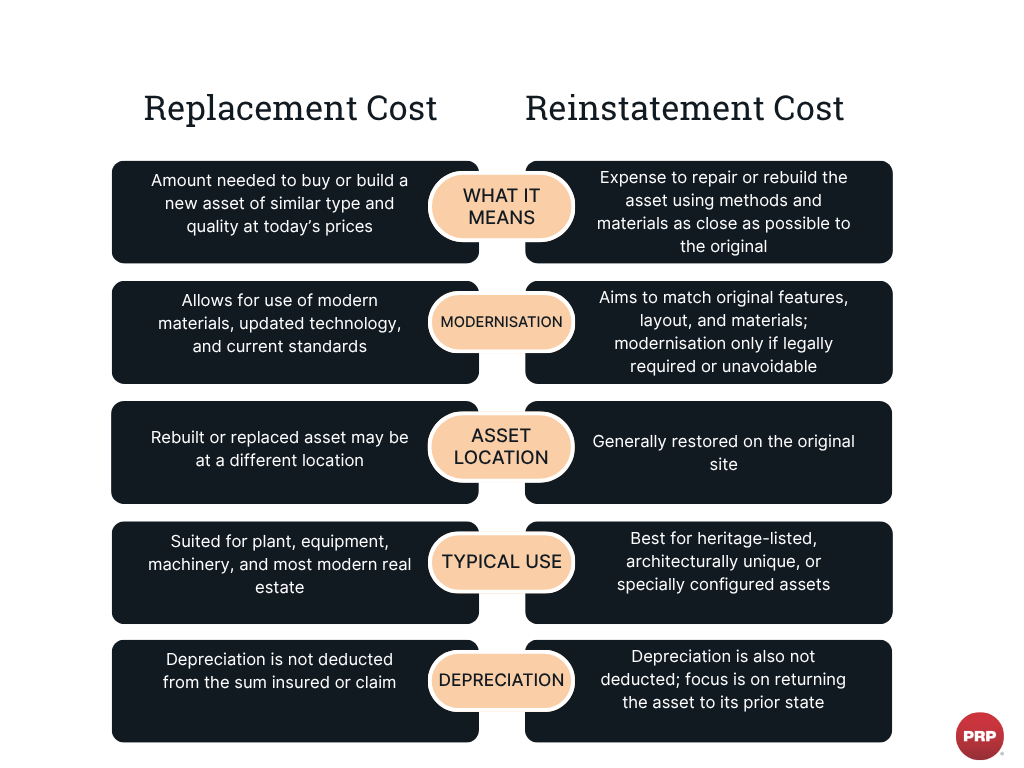
Replacement cost is the amount needed to buy or build a new asset of similar type and quality at today’s prices.
It covers the purchase or construction of a modern equivalent, regardless of location and may include updated materials or technology.
- Includes: Cost of a new, comparable asset
- Excludes: Depreciation or wear and tear
- Purpose: Allows the insured to replace their asset with a functionally similar, possibly improved version
Reinstatement cost is the expense of repairing or rebuilding an asset to its previous condition, using materials and methods as close as possible to the original, especially important for heritage or unique assets.
- Includes: Restoring or reconstructing the asset on the same site to match its original form, layout, and materials where possible
- Excludes: Upgrades or changes except those required by law or unavoidable during reinstatement
- Purpose: To return the insured to their pre-loss position, replicating the original asset as closely as possible
The Importance of Industrial Special Risk Policy Wording
In insurance for large or specialised assets, clear wording in an Industrial Special Risk (ISR) policy is crucial. Precise policy language affects claim outcomes and helps policyholders understand coverage, limits, exclusions, and settlement terms.
Defining Coverage with Precision ISR policies protect diverse industrial and commercial property portfolios. Unambiguous wording ensures there are no gaps or unexpected issues when a claim arises, supporting financial recovery.
Alignment with Asset Valuation
The valuation basis replacement or reinstatement cost should match the policy wording to avoid disputes and ensure fair compensation.
Clear, detailed language protects the insured by specifying how losses are valued and upholding the policy’s intent.
TYPES OF INSURANCE VALUATIONS
Replacement with New:
Covers replacing lost or damaged assets with new ones, regardless of their prior condition, ensuring quick business recovery without depreciation costs.
Reinstatement:
Pays for repairing or restoring assets to their original state, ideal for maintaining asset continuity.
Indemnity Value:
Compensates based on the asset’s current value, considering depreciation, suitable for older items.
Industrial Special Risk (ISR) Policies:
Offer flexible, broad coverage for medium and large businesses by combining multiple protections in one policy.
Agreed Value Policies:
Guarantee a preset payout for losses, simplifying claims if the agreed amount reflects actual value.
Loss Adjustment:
Determines final claim payouts through expert assessment, ensuring fair and prompt resolution.
Choosing the right insurance valuation helps protect your business assets and ensures fair, efficient claims.
Options include replacement cost (current expense to rebuild without depreciation), market value (open market price, considering age and condition) and indemnity value (depreciated worth at loss).
Specialised valuations may be needed for particular assets. Selecting the appropriate method is essential for effective coverage and smooth claim settlements
Our Insurance Valuation Methodology and Approach
The foundation of our insurance assessment is outlined in the ISR Policy Wording, specifically based on the Estimated Total Limit of Liability. This limit has been determined as of the valuation date, reflecting the reinstatement cost of buildings, site improvements, and infrastructure.
Reinstatement Cost
The reinstatement cost represents the expenditure required to restore, repair, or rebuild property or assets to a condition that closely resembles their original state when new without improvement or enlargement factoring in costs that are both necessary and reasonable. These costs encompass fees for architects, surveyors, consulting engineers, legal counsel, and clerical staff associated with developing estimates, plans, specifications, quantities, tenders, and supervising works resulting from any damage.
Extra Cost of Reinstatement
Additional reinstatement costs include expenses needed to comply with requirements set by statutory regulations or relevant authorities. Such costs are incorporated into our calculation of “Reinstatement with New Value” and, where applicable, appear as sub-limits in the valuation summary.
Demolition and Removal of Debris
Demolition and removal of building debris refers to the estimated costs of demolishing, dismantling, shoring, propping, underpinning, and handling the subsequent storage and disposal of debris. It excludes content debris removal and does not account for hazardous material remediation. While these costs are excluded from the “Reinstatement with New Value” calculation, they are disclosed separately in our insurance valuation summary.
Estimated Total Limit of Liability
The Estimated Total Limit of Liability defines the insurer’s maximum pay out for any single loss or series of losses stemming from an original source or situation, subject to relevant sub-limits and deductibles. This amount includes projected cost escalations for anticipated timeframes associated with demolition, architectural and engineering processes, as well as municipal approvals for reconstruction. An additional allowance is made for potential loss occurring at the policy term’s end (12 months post-valuation). No provisions have been made for abnormal approval delays or unforeseeable issues during rebuilding.